PROCEED
The important assumption has meaningful behavioral evidence behind it.
Invest in the next thing you need to learn.
You don’t need the entire product to learn whether the idea works.
Build only enough to answer the next important question.
Then let evidence decide what deserves to happen next.
Teams often confuse an MVP with a smaller version of the final product.
It isn’t.
The purpose of an MVP is not to demonstrate everything the product could eventually become.
Its job is to test something.
What is the most important assumption standing between you and the next investment?
Can you test it without building everything else?
If the answer is yes, build that first.
The smaller the experiment, the faster you learn.
And the cheaper it is to be wrong.
Imagine you’re building a new product.
You believe customers will pay for an AI system that automatically completes a particular workflow.
You could spend six months building:
Or you could ask:
Perhaps:
Will a customer actually pay us to automate this workflow?
If that’s the uncertainty that matters, build only enough to answer it.
Everything else can wait.
What are you building right now?
Ask yourself:
Write the assumption down plainly.
“We believe customers will…”
Don’t test what is easy.
Test what matters.
Not the smallest product you can build.
The smallest experiment that can produce meaningful evidence.
Decide what evidence means before you run the experiment.
What did the market actually tell you?
The important assumption has meaningful behavioral evidence behind it.
Invest in the next thing you need to learn.
There is interest, but the evidence doesn’t support the current assumption strongly enough.
Change the experiment, proposition or solution and test again.
The behavior contradicts the assumption and repeated evidence isn’t improving.
Don’t let sunk cost turn belief into strategy.
BOOKMINT NOTE
You just experienced one idea without having to consume the entire book.
This is part of the Bookmint experience — not part of The Inevitable Product law itself.
Bookmint treats a book as more than one indivisible product. Individual laws, ideas, stories and chapters can become independently discoverable experiences.
Read it. Listen to it. Save it. Share it. Buy it.
Then decide whether you want more.
BOOKMINT EXAMPLE — NOT PART OF THE ORIGINAL LAW
The principle you just read also happens to explain something fundamental about Bookmint itself.
An author might ultimately create:
But perhaps the first question is much simpler:
Does anyone care about this story or idea enough to read, listen, follow or pay for it?
Bookmint helps you invert the traditional publishing model.
The smallest publishable unit doesn’t have to be the entire book.
It can be one valuable idea.
BOOKMINT EXPERIENCE
You have several ways to continue.
BOOKMINT + ATLAS EXPERIENCE
You don’t even need to know which law to read.
Try:
“We’re six months into development and haven’t shown the product to a customer.”
Or:
“Customers love our demos but nobody is paying.”
Or:
“We have 30 features planned. How do we decide what to build first?”
Atlas can understand what you’re dealing with and help find the relevant ideas inside The Inevitable Product.
Don’t search the book. Ask the book.
Ask Atlas →BOOKMINT EXPERIENCE
BOOKMINT NOTE
One law was enough.
That’s part of the Bookmint idea.
You didn’t need all 46 laws to get value from The Inevitable Product today.
You needed the right idea for the decision in front of you.
Tomorrow you may need another.
Bookmint turns a book into a collection of independently valuable ideas — discoverable, readable, listenable and purchasable one at a time.
Continue with
Scan to continue in Bookmint on Atlas.
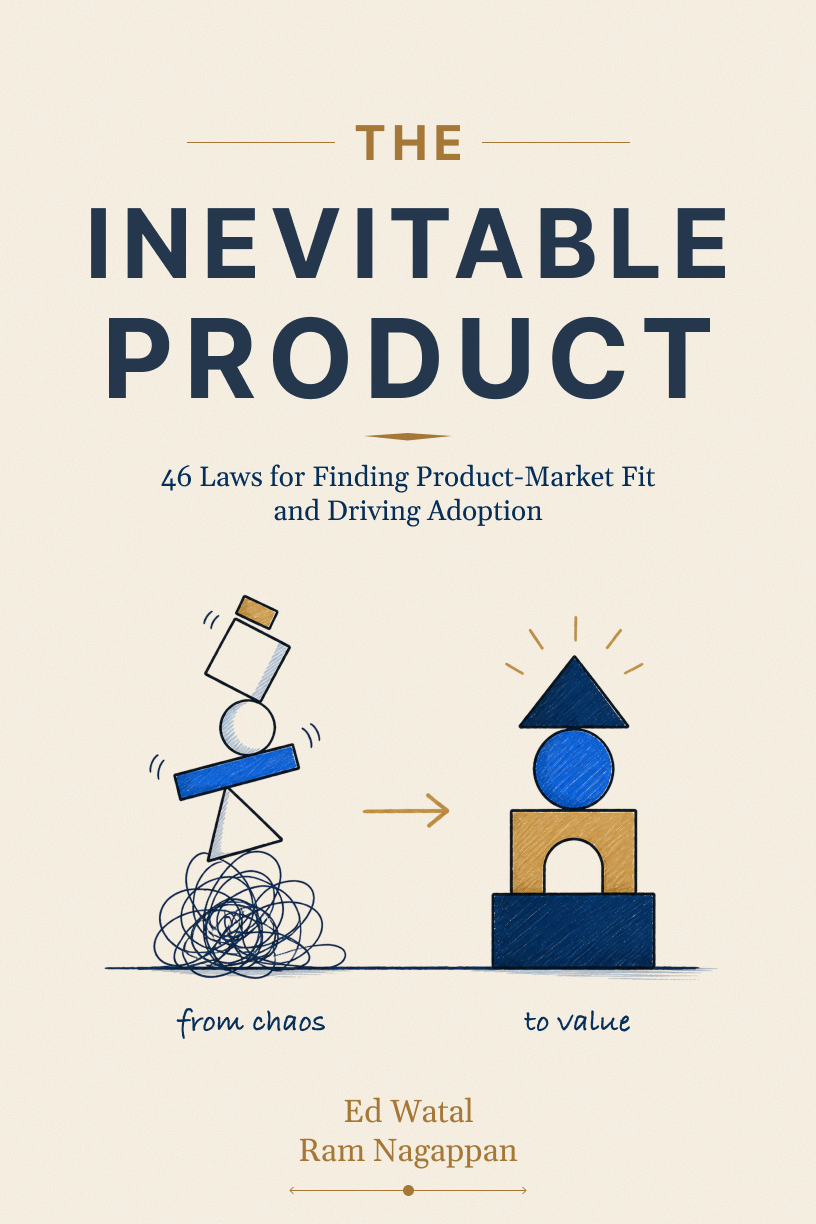
46 Laws for Finding Market Fit and Earning Adoption
Explore the Complete Book →